Foreword
These three shining names represent the triumph of the idealism of youth, and we would not speak of them with such reverence today had their motives been less pure or had they ever for an instant thought of themselves or their place in history.
So it was with Lindbergh, and all the praise awarded him, judged by the rigid standards of history and precedent, he has merited. He was the instrument of a great ideal and one need not be fanatically religious to see in his success the guiding hand of providence.
For he was needed and he came at the moment which seemed exactly preordained. He was needed by France and needed by America, and had his arrival been merely the triumph of a great adventure the influence of his act would have gone no further than have other great sporting and commercial achievements.
There have been moments here in France when all that my eye could reach or my intelligence fathom appeared dark and foreboding and yet, in spite of all, my soul would be warmed as by invisible sunshine. At such times when all human efforts had apparently failed, suddenly the affairs of nations seemed to be taken from out of the hands of men and directed by an unseen power on high.
Just before the Battle of the Marne I was standing on the Seine embankment.
A great harvest moon was rising over the city near Notre Dame. It seemed to rest on the corner of a building. The French flag was blowing steadily across its face. In fleeting moments while this spectacle lasted people knelt on the quay in prayer. I inquired the meaning of these prayers. The answer was that there is a prophecy centuries old that the fate of France will finally be settled upon the fields where Attila’s horde was halted and driven back and where many battles in defence of France have been won. And pointing up the Seine to the French flag outlined across the moon people cried, “See, see the sign in heaven. It means the victory of French arms. The prophecy of old is come true and France is once again to be saved on those chalky fields.”
Now when this boy of ours came unheralded out of the air, and circling the Eiffel tower settled to rest as gently as a bird on the field at Le Bourget, I was seized with the same premonition as those French people on the quay that August night. I felt without knowing why, that his arrival was far more than a fine deed well accomplished, and there glowed within me the prescience of splendor yet to come. Lo! it did come and has gone on spreading its beneficence upon two sister nations which a now-conquered ocean joins.
For I feel with every fibre of my being that Lindbergh’s landing here marks one of the supreme moments in the history of America and France, and the faith we have in the deciding power of spiritual things is strengthened by every circumstance of his journey, by all his acts after landing, and by the electrical thrill which ran like some religious emotion through a whole vast population. The Spirit of St. Louis was to the French people another sign come out of the sky—a sign which bore the promise that all would be well between them and us.
What a happy inspiration it was to christen his ship with such a name! It brought as from on high a new spiritual message of peace and goodwill, and it was more than a coincidence that Lindbergh should drop from his ship his farewell message to Paris on that spot, in the Place de la Concorde, where once the Spirit of Saint Louis was invoked in tragic circumstances. The priest who stood there beside King Louis the Sixteenth as the guillotine fell, cried defiantly to the assembled mob: “The Spirit of Saint Louis ascends to the skies.” With Lindbergh, out of the skies, the noble Spirit of Saint Louis came back to France.
France took Charles Lindbergh to her heart because of what he was and because of what she knew he represented. His little ship came to the meeting place of the greatest conference that has ever gathered between two nations, for under the shadow of its wings a hundred and fifty million Frenchmen and Americans have come together in generous accord. No diplomatic bag ever carried so stupendous a document as this all unaccredited messenger bore, and no visiting squadron ever delivered such a letter of thanks as he took up the Potomac in returning. Has any such Ambassador ever been known?
Lindbergh was not commissioned by our government any more than Lafayette was by his; in each case it has been merely left for statesmen to register and approve the vast consequences of their acts. Both arrived at the critical moment and both set in motion those imponderable forces which escape the standards of the politician’s mind. Who shall say but that they were God-sent messengers of help, smiling defiance of their faith at an all too skeptical world? What one accomplished has already changed history through a century; what the other has just done the people of America and France will take good care shall not be wasted.
The way Lindbergh bore himself after getting here was but the continuation of his flight. He started with no purpose but to arrive. He remained with no desire but to serve. He sought nothing; he was offered all. No flaw marked any act or word, and he stood forth amidst clamor and crowds the very embodiment of fearless, kindly, cultivated, American youth—unspoiled, unspoilable. A nation which breeds such boys need never fear for its future. When a contract for one million dollars was sent him through his associates he cabled back to them, “You must remember this expedition was not organized to make money but to advance aviation.” There is the measure of his spirit; the key to his intentions.
Flying was his trade, his means of livelihood. But the love of it burned in him with fine passion, and now that his fame will give him a wider scope of usefulness, he has announced that he will devote himself wholeheartedly to the advancement of aeronautics.
His first step in that direction is the publishing of this book, and no one can doubt that its influence will be of enormous value in pushing on man’s conquest of the air. It will be idle for me or anyone else to estimate now what these results will be. But America vibrates with glowing pride at the thought that out from our country has come this fresh spirit of the air and that the whole world hails Lindbergh not only as a brave aviator but as an example of American idealism, character and conduct.
Myron T. Herrick.
United States Embassy
Paris
Frontispiece
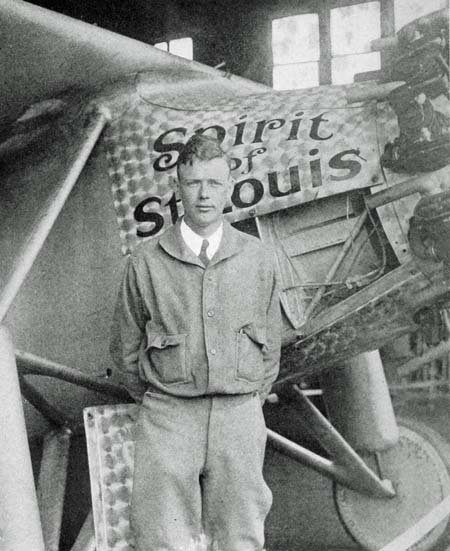
“We”
“We”
I: Boyhood and Early Flights
I
Boyhood and Early Flights
I was born in Detroit, Michigan, on February 4, 1902. My father was practicing law in Little Falls, Minnesota, at the time. When I was less than two months old my parents took me to their farm, on the western banks of the Mississippi River two miles south of Little Falls.
My father, Charles A. Lindbergh, was born in Stockholm, Sweden, January 20, 1860, the son of Ola and Louisa Manson. His father (who changed his name to Lindbergh after reaching America) was a member of the Swedish Parliament and had at one time been Secretary to the King.
About 1860 my grandfather with his family embarked on a ship bound for America, and settled near Sauk Center, Minnesota, where he took up a homestead and built his first home in America—a log cabin. It was here that my father spent his early life.
The Rev. C. S. Harrison, writing for the Minnesota Historical Society, gives an account of the activities of my grandfather during the early days in Minnesota.
There were very few schools in Minnesota at that time, and my father’s boyhood days were spent mostly in hunting and fishing. His education consisted largely of home study with an occasional short term at country schools.
He was educated at Grove Lake Academy, Minnesota, and graduated from the law school at the University of Michigan, Ann Arbor, with an LL.B. degree.
He began his law practice in Little Falls where he served as County Attorney. He later became interested in politics, and was elected to the 60th Congress in 1906 to represent the Sixth District of Minnesota at Washington, a capacity in which he served for ten years.
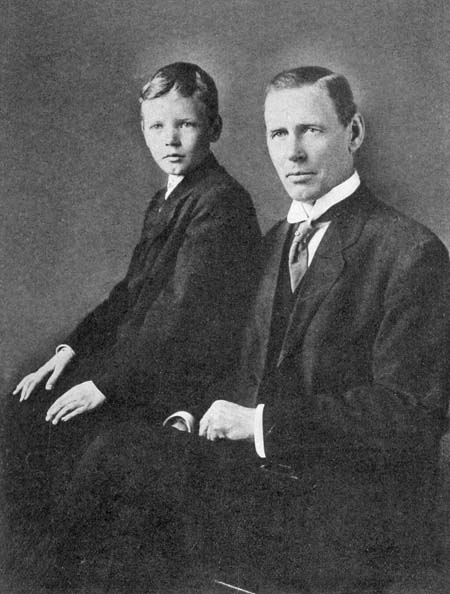
My mother was born in Detroit, Michigan, daughter of Charles and Evangeline Land. She is of English, Irish and French extraction. As a graduate of the University of Michigan, she holds a B.S. degree from that institution, also an A.M. degree from Columbia University, New York City. Her father, Dr. Charles H. Land, a Detroit dentist, was born in Simcoe, Norfolk County, Canada, and his father, Colonel John Scott Land, came from England, and was one of the founders of the present city of Hamilton.
My grandfather was constantly experimenting in his laboratory. He held a number of patents on incandescent grates and furnaces, in addition to several on gold and enamel inlays and other dental processes. He was one of the first to foresee the possibilities of porcelain in dentistry, and later became known as “the father of porcelain dental art.”
During the first four years of my life, I lived in our Minnesota home with the exception of a few trips to Detroit. Then my father was elected to Congress and thereafter I seldom spent more than a few months in the same place. Our winters were passed in Washington, and our summers in Minnesota, with intermediate visits to Detroit.
When I was eight years of age I entered the Force School in Washington. My schooling was very irregular due to our constant moving from place to place. Up to the time I entered the University of Wisconsin I had never attended for one full school year, and I had received instruction from over a dozen institutions, both public and private, from Washington to California.
Through these years I crossed and recrossed the United States, made one trip to Panama, and had thoroughly developed a desire for travel, which has never been overcome.
My chief interest in school lay along mechanical and scientific lines. Consequently, after graduating from the Little Falls High School, I decided to take a course in Mechanical Engineering, and two years later entered the College of Engineering of the University of Wisconsin at Madison.
While I was attending the University I became intensely interested in aviation. Since I saw my first airplane near Washington DC, in 1912, I had been fascinated with flying, although up to the time I enrolled in a flying school in 1922 I had never been near enough a plane to touch it.
The long hours of study at college were very trying for me. I had spent most of my life outdoors and had never before found it necessary to spend more than a part of my time in study.
At Wisconsin my chief recreation consisted of shooting-matches with the rifle and pistol teams of rival Universities, and in running around on my motorcycle which I had ridden down from Minnesota when I entered the University.
I had been raised with a gun on our Minnesota home, and found a place on the R.O.T.C. teams at the beginning of my freshman year at Wisconsin. From then on I spent every minute I could steal from my studies in the shooting gallery and on the range.