 foxing
Loading books
Public-domain books free to read
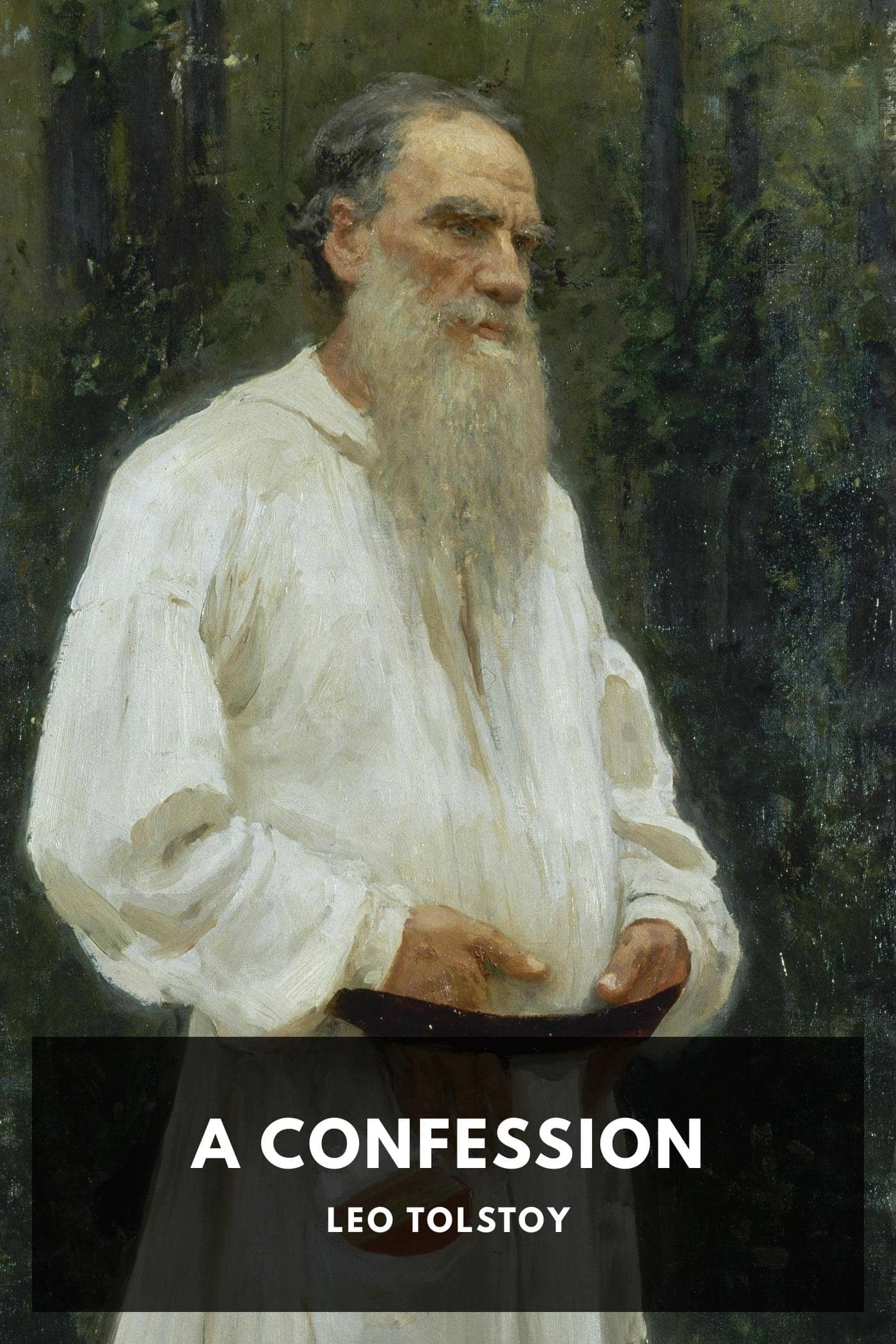
by Leo Tolstoy
In this starkly honest autobiographical work, Leo Tolstoy recounts his midlife existential crisis, plunging into despair over the meaning of life. Wrestling with reason, science, and faith, he ultimately finds solace in the simple faith of ordinary people. A timeless exploration of doubt and spiritual awakening.
A Confession is Leo Tolstoy's unflinching account of his spiritual crisis in the 1870s, after completing War and Peace and Anna Karenina. The book charts his journey from aristocratic success to profound despair, as he confronts the question: what makes life worth living in the face of inevitable death?
Tolstoy systematically examines the answers offered by science, philosophy, and the Orthodox Church of his upbringing, finding each insufficient. He describes his suicidal depression with raw clarity, and his eventual turn to the faith of the Russian peasantry — not as a set of doctrines, but as a lived, communal practice that gives meaning to suffering and mortality.
Written in a direct, confessional style, the work is both a personal testimony and a philosophical inquiry. It resonates with anyone who has grappled with existential doubt or sought purpose beyond material success. This edition includes the full text of Tolstoy's original 1882 manuscript, which was censored in Russia for its critique of church and state.
Opening
A few passages to enter the atmosphere.
I was baptized and brought up in the Orthodox Christian faith. I was taught it in childhood and throughout my boyhood and youth. But when I abandoned the second course of the university at the age of eighteen I no longer believed any of the things I had been taught.
Judging by certain memories, I never seriously believed them, but had merely relied on what I was taught and on what was professed by the grown-up people around me, and that reliance was very unstable.
I remember that before I was eleven a grammar school pupil, Vladimir Milyutin (long since dead), visited us one Sunday and announced as the latest novelty a discovery made at his school. This discovery was that there is no God and that all we are taught about Him is a mere invention (this was in 1838). I remember how interested my elder brothers were in this information. They called me to their council and we all, I remember, became very animated, and accepted it as something very interesting and quite possible.
A Confession
Continue readingI remember also that when my elder brother, Dmitriy, who was then at the university, suddenly, in the passionate way natural to him, devoted himself to religion and began to attend all the Church services, to fast and to lead a pure and moral life, we all—even our elders—unceasingly held him up to ridicule and for some unknown reason called him “Noah.” I remember that Musin-Pushkin, the then Curator of Kazan University, when inviting us to dance at his home, ironically persuaded my brother (who was declining the invitation) by the argument that even David danced before the Ark. I sympathized with these jokes made by my elders, and drew from them the conclusion that though it is necessary to learn the catechism and go to church, one must not take such things too seriously. I remember also that I read Voltaire when I was very young, and that his raillery, far from shocking me, amused me very much.
My lapse from faith occurred as is usual among people on our level of education. In most cases, I think, it happens thus: a man lives like everybody else, on the basis of principles not merely having nothing in common with religious doctrine, but generally opposed to it; religious doctrine does not play a part in life, in intercourse with others it is never encountered, and in a man’s own life he never has to reckon with it. Religious doctrine is professed far away from life and independently of it. If it is encountered, it is only as an external phenomenon disconnected from life.
The book is free to read. AI co-reading includes a limited free trial.
Open the reader