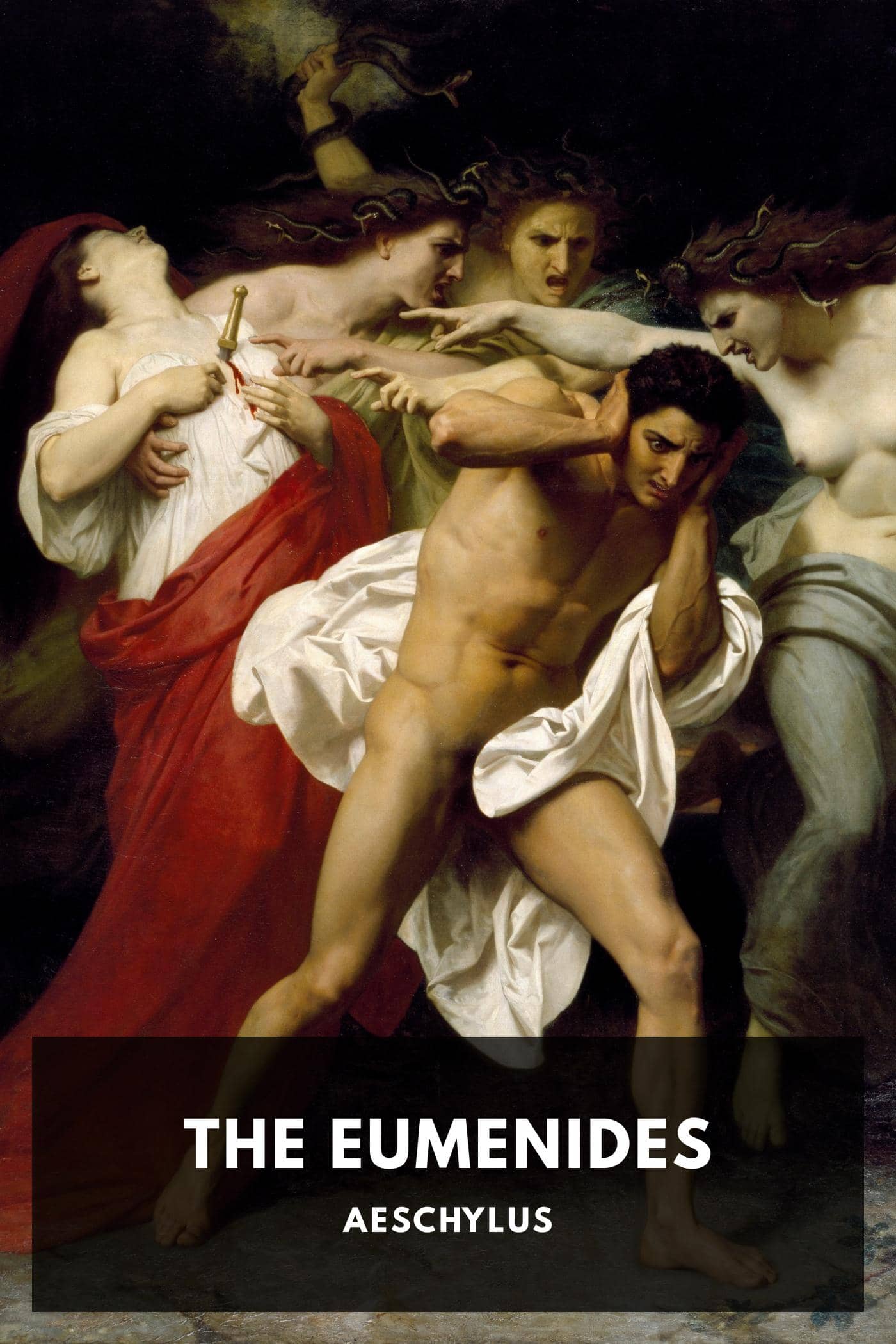
Books free forever
by Aeschylus
A man is pursued by wrathful goddesses for avenging his father’s murder, and finds refuge in Athens where a trial determines his fate.
Opening
A few passages to enter the atmosphere.
The Scene represents the front of the Temple of Apollo at Delphi; great doors at the back lead to the inner shrine and the central Altar. The Pythian Prophetess is standing before the Doors.4
First of all Gods I worship in this prayer5
Earth, the primeval prophet; after her
Themis, the Wise, who on her mother’s throne—
So runs the tale—sat second; by whose own
Accepted will, with never strife nor stress,
Third reigned another earth-born Titaness,
Phoebe; from whom (for that he bears her name)
To Phoebus as a birthtide gift it came.
He left his isle, he left his Delian seas,6
He passed Athena’s wave-worn promontories,
In haste this great Parnassus to possess
And Delphi, thronèd in the wilderness.
And with him came, to escort him and revere,
A folk born of Hephaistos, pioneer
Of God’s way, making sweet a bitter land.
And much this people and the King whose hand
Then steered them, Delphos, glorified his name,
Till Zeus into his heart put mystic flame
And prophet here enthroned him, fourth in use:
So Loxias’ lips reveal the thought of Zeus.7
The Eumenides
Continue reading
These gods be foremost in all prayers of mine,
Who have held the Throne. Next, She before the shrine,
Pallas, is praisèd, and the Nymphs who keep
Yon old Corycian bird-belovèd steep,
Deep-caverned, where things blessèd come and go.
And Bromios walks the mountain, well I know,
Since first he led his Maenad host on high
And doomed King Pentheus like a hare to die.8
And Pleistos’ fountains and Poseidon’s power
I call, and Him who brings the Perfect Hour,
Zeus, the Most Highest. With which prayers I go
To seat me, priestess, on the Throne. And, oh,
May God send blessing on mine entrance, more
And deeper than He e’er hath sent of yore!
If there be present men of Greece but not
Of Delphi, let them enter as the lot
Ordains; I speak but as God leadeth me. She enters the Inner Shrine, and the stage is for a moment empty. Then she returns, grasping at the wall for support.
Ah! Horrors, horrors, dire to speak or see,
From Loxias’ chamber drive me reeling back.
My knees are weak beneath me, and I lack
The strength to fly. … O hands, drag me from here
If feet fail! … An old woman, and in fear,
A thing of naught, a babe in helplessness!
I made my way into the Holy Place,
And there, at the inmost Altar of the world,
A man abhorred of God, his body hurled
Earthward in desperate prayer; blood on his hand9
Yet reeking, and a naked new-drawn brand
Wreathed in beseeching wool, a suppliant’s weed
Of snow-white fleece … so much mine eyes could read.
But out in front of him a rout unknown
Of women sleepeth, flung from throne to throne.
Women? Nay, never women! Gorgons more:
And yet not like the Gorgon shapes of yore. …10
I saw a picture once of woman things
That ravished Phineus’ banquet. But no wings
Have these; all shadows, black, abominable.
The voices of their slumber rise and swell,
Back-beating, and their eyes drop gouts of gore.
Their garb, it is no garb to show before
God’s altar nor the hearths of human kind.
I cannot read what lineage lies behind
These shapes, nor what land, having born such breed,
Hath trembled not before and shall not bleed
Hereafter. Let Apollo great in power
Take to his care the peril of this hour:
Being Helper, Prophet, Seer of things unseen,
The stainèd hearth he knoweth to make clean. The Prophetess departs. The doors open and reveal the inner shrine, Orestes at the Altar, the Furies asleep about him, and Apollo standing over them.11
I fail thee not. For ever more I stay,
Or watching at thy side or far away,
Thy guard, and iron against thine enemies.
Even now my snares have closèd upon these,
The ragers sleep: the Virgins without love,
So grey, so old, whom never god above
Hath kissed, nor man, nor from the wilderness
One wild beast. They were born for wickedness
And sorrow;12 for in evil night they dwell,
And feed on the great darkness that is Hell,
Most hated by the Gods and human thought.
But none the less, fly thou and falter not.
For these shall hunt thee, ever on through earth
Unwandered, through the vast lands of the North,
The sea-ways and the cities ringed with sea.
But faint not. Clasp thy travail unto thee;
On till thou come to Pallas’ Rock,13 and fold
Thine arms in prayer about her image old.
In Athens there be hearts to judge, there be
Words that bring peace; and I shall set thee free
At last from all this woe.—If thou didst kill
Thy mother, was it not my word and will?